WordPress vs Shopify vs Custom Website: Which One Is Right for Your Business in 2026?
Choosing the right platform is one of the first major decisions when building a new website. Should you use WordPress? Should you build your online store with Shopify? Or does your business need a completely custom website?
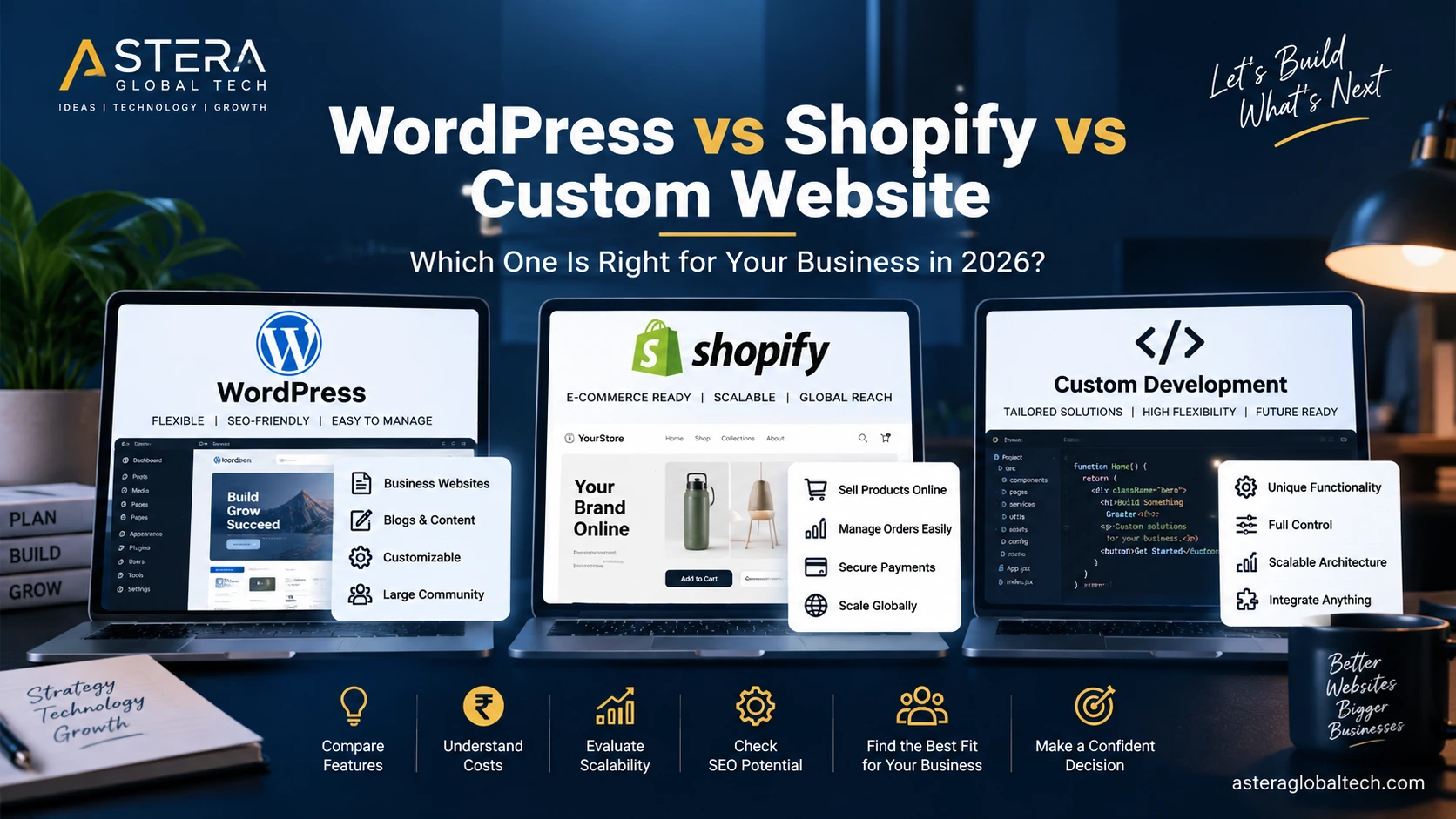
WordPress vs Shopify vs Custom Website: Which One Is Right for Your Business in 2026?
Choosing the right platform is one of the first major decisions when building a new website.
Should you use WordPress?
Should you build your online store with Shopify?
Or does your business need a completely custom website?
There is no single platform that is right for every business. The right choice depends on what you want your website to accomplish, how much customization you need, your budget, your growth plans and how you intend to manage the website in the future.
In this guide, we’ll break down the differences between WordPress, Shopify and custom website development to help businesses make a more informed decision.
Why Your Website Platform Matters
Your website platform affects much more than how your website looks.
It can influence:
- Website performance
- SEO capabilities
- Security
- Scalability
- Integrations
- Content management
- E-commerce functionality
- Maintenance requirements
- Development cost
- Future expansion
Choosing a platform simply because it is cheaper or popular can create problems later when your business needs functionality the platform was never intended to provide.
The better approach is to choose technology based on your business requirements and future roadmap.
What Is WordPress?
WordPress is one of the world's most widely used content management systems.
It can be used to build business websites, corporate websites, blogs, service websites, portfolios, landing pages and even e-commerce stores using WooCommerce.
One of WordPress's biggest advantages is flexibility.
Businesses can manage pages, publish blogs, optimize content for search engines and extend functionality through plugins or custom development.
WordPress Is Usually Suitable For:
Business and corporate websites, service-based companies, content-heavy websites, blogs and publications, SEO-focused websites, portfolios, educational websites and WooCommerce stores.
Advantages of WordPress
Easy content management
Your team can update pages, blogs, images and other content without having to modify the website's source code every time.
Strong SEO capabilities
WordPress provides considerable flexibility for managing metadata, URLs, structured content, internal linking, sitemaps and other technical SEO elements.
Highly customizable
A WordPress website doesn't have to look like a template. A custom WordPress theme can be designed around a company's branding and business requirements.
Large ecosystem
There are thousands of integrations, plugins and development tools available.
However, WordPress websites also need proper maintenance.
Poor-quality plugins, outdated themes and inadequate security practices can create performance and security problems.
What Is Shopify?
Shopify is primarily an e-commerce platform.
It provides businesses with the infrastructure required to sell products online without building the entire commerce system from scratch.
Products, inventory, orders, payments, discounts and customer information can be managed from one dashboard.
For businesses whose primary goal is selling products online, Shopify can significantly simplify operations.
Shopify Is Usually Suitable For:
D2C brands, fashion stores, beauty brands, lifestyle products, electronics, food brands, growing e-commerce businesses and international online stores.
Advantages of Shopify
Built specifically for e-commerce
Many essential commerce features are available from the beginning.
Simpler store management
Products, orders, customers and inventory can be managed through a centralized system.
Scalable infrastructure
Businesses can start relatively small and expand as their online sales grow.
Large application ecosystem
Additional functionality can be introduced through Shopify apps and custom integrations.
However, businesses should also consider recurring subscription costs, app costs and platform limitations when highly customized functionality is required.
What Is Custom Website Development?
A custom website is developed specifically around the requirements of a particular business.
Instead of adapting the business to an existing theme or platform, developers can create the required architecture, functionality and user experience.
Depending on the project, custom development may use technologies such as PHP, Laravel, React, Next.js, Node.js or other modern frameworks.
Custom Development Is Usually Suitable For:
SaaS platforms, job portals, marketplaces, booking systems, complex dashboards, membership platforms, enterprise applications and businesses requiring specialized workflows.
Advantages of Custom Development
The primary advantage is control.
Developers can determine how the application works, how information is stored, how users interact with the system and how external services are integrated.
Custom development can also provide greater flexibility when a project has requirements that cannot easily be achieved using standard plugins or applications.
The trade-off is that custom development normally requires more planning, development time, testing and technical maintenance.
WordPress vs Shopify vs Custom Development
Here is a simplified comparison:
| Requirement | WordPress | Shopify | Custom |
|---|---|---|---|
| Business Website | Excellent | Limited | Excellent |
| Blogging | Excellent | Good | Custom-built |
| E-commerce | Good with WooCommerce | Excellent | Custom-built |
| Content Management | Excellent | Good | Depends on development |
| Custom Functionality | High | Moderate–High | Very High |
| Initial Development | Usually Faster | Usually Faster | Usually Longer |
| Maintenance | Required | Mostly Managed | Required |
| SEO Flexibility | High | High | Very High |
| Complex Workflows | Moderate | Moderate | Excellent |
| Scalability | High when optimized | High | Architecture-dependent |
The table does not mean one technology is universally better than another.
Each solves a different type of problem.
When Should You Choose WordPress?
Consider WordPress when your website primarily needs to:
Generate leads, rank organically on Google, publish regular content, explain your services, showcase your portfolio or allow your internal team to manage content easily.
For example, a digital agency, consulting company, law firm, healthcare practice or B2B service company may not require a custom application.
A well-developed WordPress website could provide everything the business needs while keeping content management relatively straightforward.
When Should You Choose Shopify?
Shopify becomes particularly attractive when selling products is the primary purpose of the website.
Suppose you're launching a D2C brand with 100 products.
You need product management, inventory, payments, discount codes, shipping integrations, order management and customer accounts.
Building all of these systems independently would require significant development.
Shopify already provides much of this infrastructure.
The development effort can therefore focus more heavily on branding, user experience, conversion optimization and integrations.
When Should You Choose Custom Development?
Custom development starts making more sense when your business requirements become unique.
Imagine you're building a recruitment platform.
You might need:
Candidate accounts, employer accounts, resume uploads, job posting, application tracking, automated candidate screening, subscriptions, dashboards and administrator controls.
Trying to combine dozens of plugins to create such a system may eventually become difficult to maintain.
A properly architected custom application may be more appropriate.
What About Website Cost?
Website cost shouldn't be evaluated only by asking:
"How much does it cost to build?"
Businesses should also consider:
"How much will it cost to operate, maintain and expand?"
A cheaper website that requires rebuilding after one year can ultimately cost more than a properly planned website.
Likewise, paying for custom development when a straightforward WordPress website would meet all requirements may be unnecessary.
Your budget should therefore be evaluated together with the project's actual requirements.
What About SEO?
All three approaches can support SEO when implemented correctly.
However, the implementation differs.
WordPress provides a mature content-management environment and extensive SEO tooling.
Shopify provides solid e-commerce SEO capabilities but has some platform-specific structural limitations.
Custom development gives developers substantial technical control, but SEO functionality must be intentionally implemented.
The platform alone will not produce rankings.
SEO also depends on content quality, search intent, website architecture, technical performance, backlinks, user experience and competition.
Don't Choose Technology Before Understanding the Requirement
One of the most common mistakes in website projects is deciding the technology before defining what needs to be built.
A better development process begins with questions such as:
Who will use the website?
What should users be able to do?
Will products be sold online?
Who will update the content?
Are third-party integrations required?
What functionality might be required in the next two or three years?
Once these questions are answered, choosing the technology becomes much easier.
Final Thoughts
WordPress, Shopify and custom development are tools—not competitors.
WordPress can be an excellent choice for content-driven and service-based businesses.
Shopify can provide a strong foundation for e-commerce brands.
Custom development can be appropriate when a business needs specialized functionality, workflows or applications.
The important part is matching the technology to the business instead of forcing the business into a particular technology.
At Astera Global Tech, we work across WordPress, Shopify and custom website development, which allows us to evaluate projects based on their requirements rather than pushing every business toward the same platform.
Planning a new website or considering rebuilding your existing one?
We can review your requirements and help you understand which development approach fits your business, budget and long-term plans.
Astera Global Tech
Ideas | Technology | Growth
Let’s Build What’s Next.