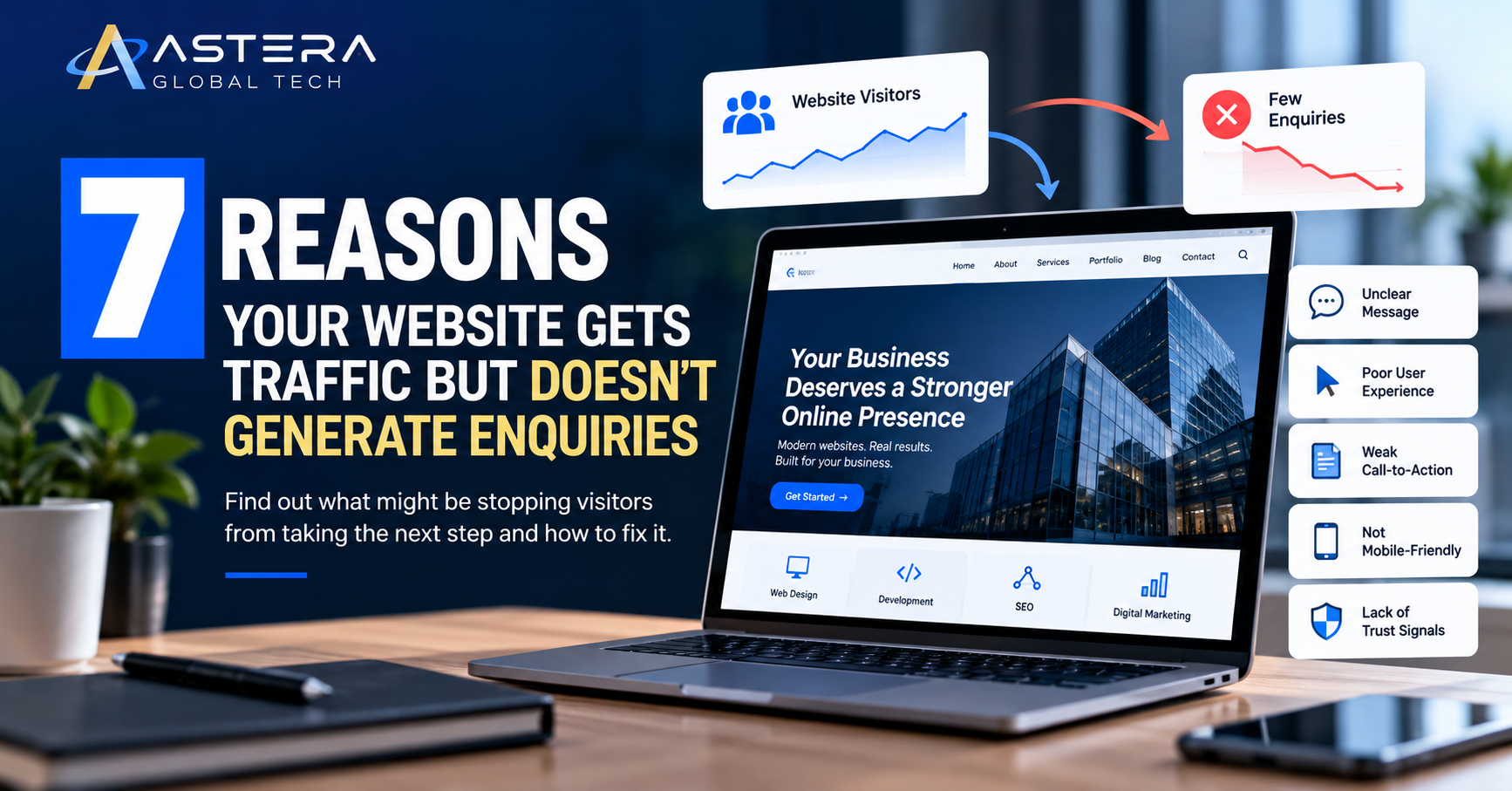
7 Reasons Your Website Gets Traffic But Doesn’t Generate Enquiries
Your website is getting visitors, but they aren’t turning into enquiries. Discover 7 common website issues that may be stopping potential customers from taking the next step.
Getting visitors to your website is a positive sign. It means people are discovering your business through Google, social media, advertising, referrals or other channels.
But there is an important question:
What happens after they arrive?
If your website receives traffic but generates very few calls, contact-form submissions, WhatsApp enquiries or quote requests, increasing traffic alone may not solve the problem.
The issue could be the experience visitors have once they land on your website.
A business website should help visitors quickly understand what you offer, why they should trust you and what they should do next.
Here are seven common reasons your website may be getting traffic without generating enough enquiries.
1. Your Website Message Isn't Clear
Visitors should be able to understand your business within the first few moments of landing on your website.
A homepage filled with impressive-looking phrases but no clear explanation of your services can create confusion.
Your website should quickly answer:
- What does your business offer?
- Who do you help?
- What problem do you solve?
- Why should someone choose you?
- What should the visitor do next?
For example, instead of a vague headline such as “Building Digital Experiences for Tomorrow,” a web development company could communicate more clearly with:
“Custom Website Development for Businesses That Want to Build and Grow Online.”
Creativity is valuable, but clarity should come first.
2. Poor User Experience Is Making Visitors Leave
A website can look impressive and still be difficult to use.
Complicated navigation, cluttered pages, inconsistent layouts, difficult-to-read text and too many choices can make visitors work harder than necessary.
Good user experience should make the journey feel natural.
A potential customer should be able to move easily from:
Homepage → Service → Proof/Portfolio → Contact
Review your website from the perspective of someone who has never seen your business before.
Can they find your services easily?
Can they understand the page without reading every paragraph?
Can they find your contact information?
If not, your UX may be creating unnecessary friction.
3. Your Calls-to-Action Are Too Weak
After explaining your services, you need to tell visitors what they can do next.
This is where a clear call-to-action (CTA) becomes important.
Depending on your business, examples could include:
- Request a Quote
- Book a Consultation
- Discuss Your Project
- Contact Our Team
- WhatsApp Us
- View Our Work
- Get Started
A common mistake is placing one Contact Us button at the bottom of a long page and expecting every visitor to reach it.
CTAs should appear naturally at important stages of the customer journey.
The objective isn't to fill every section with buttons. It is to make the next step obvious when a visitor is ready.
4. Your Website Isn't Properly Optimized for Mobile
Your website may look excellent on a desktop and still provide a frustrating experience on a smartphone.
Common mobile problems include:
- Text that is too small
- Buttons that are difficult to tap
- Images extending outside the screen
- Complicated navigation menus
- Forms that are difficult to complete
- Excessive spacing
- Slow-loading pages
Responsive website design isn't simply about making a desktop website smaller.
The experience should be designed to work effectively across different screen sizes.
Test your important pages on multiple mobile devices and pay particular attention to navigation, forms, CTAs and page speed.
5. Visitors Don't Have Enough Reasons to Trust You
Before contacting a business online, potential customers often look for evidence that the company is credible.
Your website can build confidence through genuine trust signals such as:
- Customer reviews
- Client testimonials
- Portfolio projects
- Case studies
- Clear company information
- Founder or team information
- Business contact details
- Relevant certifications or partnerships
- Transparent service information
Avoid adding impressive statistics simply because they look good.
If you display numbers such as projects completed, customer satisfaction rates or business results, they should be based on information you can substantiate.
Real proof is more valuable than exaggerated claims.
6. Your Website Is Too Slow
Every additional obstacle between a visitor and the information they need can affect their experience.
Website performance can be influenced by:
- Large, unoptimized images
- Excessive scripts
- Too many plugins
- Heavy animations
- Poorly optimized code
- Third-party integrations
- Inadequate hosting
- Missing caching or optimization
Performance should therefore be considered throughout the design and development process.
Start by reviewing your most important pages, particularly your homepage, service pages and landing pages.
A faster website provides a better experience and also supports your broader technical SEO efforts.
7. You're Attracting Traffic That Doesn't Match Your Services
Not every visitor is a potential customer.
A website can receive significant traffic and still generate limited business if that traffic comes from people whose search intent doesn't match what the company offers.
For example, an article may attract visitors looking for free information while your business is trying to reach companies ready to hire a service provider.
This doesn't make informational content useless. Educational content can build awareness and authority.
However, your overall strategy should connect:
SEO + Content + Service Pages + User Experience + Conversion
Instead of measuring success only by total traffic, look at the quality and intent of that traffic.
How Do You Know Where the Problem Is?
Don't redesign your entire website based on assumptions.
Start with data.
Review information such as:
- Which pages receive the most traffic?
- Which pages generate enquiries?
- Where do visitors leave?
- Which devices are visitors using?
- Which search queries bring organic visitors?
- Which marketing channels generate enquiries?
- Are visitors reaching your important service pages?
Tools such as Google Analytics and Google Search Console can help you understand how people discover and interact with your website.
Combine this information with a manual review of your website experience.
Sometimes the problem isn't one major issue. It is several small points of friction across the customer journey.
More Traffic Isn't Always the Answer
When a website isn't generating enough enquiries, the immediate reaction is often:
“We need more traffic.”
But imagine doubling your traffic while keeping the same confusing messaging, poor mobile experience and weak CTAs.
You may simply double the number of people experiencing the same problems.
Before investing heavily in additional traffic, make sure your website is ready to handle the visitors you already have.
What Should a Business Website Actually Do?
A good business website should help a potential customer:
- Understand what you offer
- Determine whether your service is relevant to them
- Explore your expertise and work
- Develop confidence in your business
- Take a clear next step
Design is part of this process but design alone isn't the objective.
Your website should combine clear communication, thoughtful UI/UX, responsive development, performance and business strategy.
Final Thoughts
Your website doesn't need to pressure every visitor into becoming a customer.
It needs to make the journey easier for the right visitors.
If you're receiving traffic but very few enquiries, review the complete experience before assuming you simply need more visitors.
Look at your messaging, navigation, mobile experience, calls-to-action, trust signals, performance and traffic quality.
Small improvements in these areas can create a clearer and more useful experience for potential customers.
At Astera Global Tech, we design and develop websites around usability, performance and real business requirements — from business websites and eCommerce platforms to custom web solutions.
Is your website getting visitors but not enough enquiries? Let's discuss what's happening and identify where the experience can be improved.