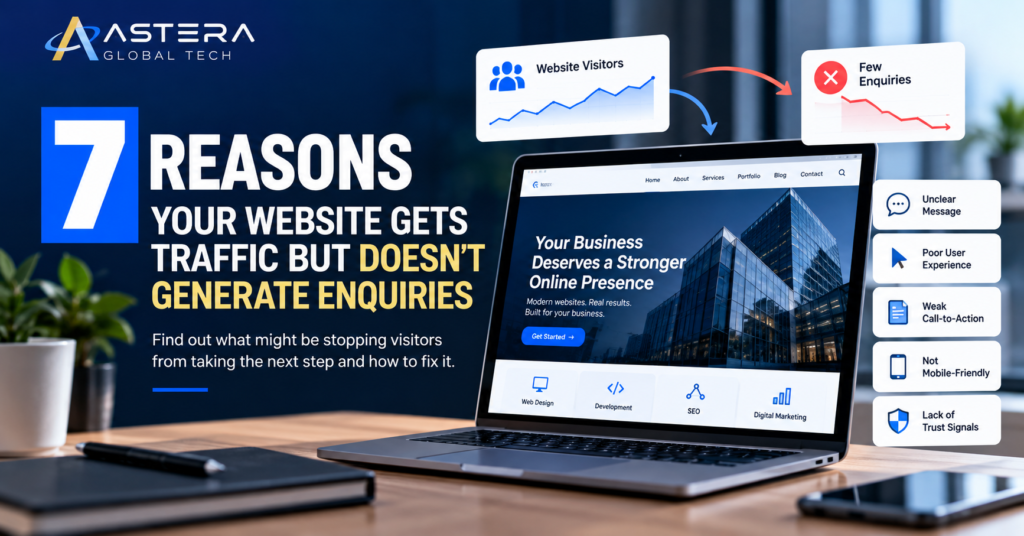
Why Your Business Website Is Not Generating Leads in 2026 (And How to Fix It)
Your website may look professional, but is it actually bringing customers to your business? Discover 10 reasons websites struggle to generate leads and learn how better SEO, user experience, content, and conversion strategies can help turn your website into a more effective business growth channel.

You invested in a professional website. Your business has a domain, a homepage, service pages, and a contact form.
But there is one important question:
Is your website actually generating business enquiries?
For many startups, small businesses, and established companies, the answer is disappointing.
A website may look attractive and still fail to generate meaningful enquiries, consultation requests, or sales opportunities.
In 2026, having a website is no longer enough. Businesses need websites that help potential customers discover their services, understand their value, build trust, and take the next step.
If your website is not generating leads, the problem may not be your business or your services. It may be the way your website attracts, informs, and guides visitors.
In this guide, we explore 10 common reasons business websites struggle to generate leads and practical improvements you can make.
What Does Website Lead Generation Mean?
Website lead generation is the process of attracting potential customers to your website and encouraging them to express interest in your products or services.
A lead might be someone who:
-
Submits a contact form.
-
Requests a quotation.
-
Books a consultation.
-
Calls your business.
-
Starts a WhatsApp conversation.
-
Requests a product demonstration.
-
Signs up for a relevant business enquiry or service.
For example, if you operate a website development company, a visitor who requests a Shopify website quotation could be a potential lead.
However, not every website visitor becomes a lead.
Your website must provide the right information, establish credibility, and make it easy for interested customers to contact you.
1. Your Website Is Not Attracting the Right Audience
One of the biggest reasons a website fails to generate leads is that it does not attract visitors who are genuinely interested in the business’s services.
A website might receive traffic from social media, search engines, or referral sources without reaching the right potential customers.
For example, a business offering premium website development services may attract visitors looking only for free website templates.
The traffic exists, but the audience may not match the services being offered.
How to Fix It
Start by identifying your ideal customers.
Consider:
-
What type of businesses do you want to serve?
-
What problems are they trying to solve?
-
Which services are they searching for?
-
What questions do they ask before contacting a provider?
Build your website content around these requirements.
For a digital agency, relevant search topics might include:
-
Website development services for small businesses.
-
Shopify website development agency.
-
Custom business website development.
-
SEO services for local businesses.
-
Website redesign services.
Key takeaway: Attracting relevant visitors is more valuable than increasing traffic without a clear business purpose.
2. Your Homepage Does Not Clearly Explain What You Offer
Visitors should understand your business within the first few seconds of exploring your homepage.
If your homepage uses vague headlines such as “Transforming Your Digital Future” without explaining your actual services, potential customers may feel confused.
A good homepage should quickly answer three questions:
-
What does your company offer?
-
Who are your services designed for?
-
What should visitors do next?
How to Fix It
Use a clear headline that communicates your services and value.
Weak example:
“Building Tomorrow’s Digital World.”
Improved example:
“Website Development, SEO & Digital Marketing Solutions for Growing Businesses.”
Support the headline with a short explanation of how your services help customers.
Add a visible call-to-action button such as:
-
Get a Free Consultation.
-
Request a Website Quote.
-
Discuss Your Project.
Your homepage should help visitors understand your services without requiring them to search through multiple pages.
3. Your Website Has Weak or Missing Calls to Action
A call to action, commonly called a CTA, tells visitors what to do next.
Even an informative website may fail to generate enquiries if visitors cannot easily find the next step.
Some businesses place a single Contact Us button in the navigation and expect visitors to locate it themselves.
This creates unnecessary friction.
How to Fix It
Place relevant CTAs throughout your website.
For example:
Homepage: “Let’s Discuss Your Project.”
Website Development Page: “Get a Website Development Quote.”
SEO Services Page: “Request an SEO Consultation.”
Portfolio Page: “Build Something Similar for Your Business.”
Keep your CTA language specific and relevant to the page.
Avoid overwhelming visitors with too many competing actions.
Key takeaway: Every important service page should provide a clear and convenient path to enquiry.
4. Your Website Is Not Optimized for Mobile Users
Many customers discover businesses while browsing on smartphones.
If your website is difficult to navigate on mobile devices, visitors may leave before submitting an enquiry.
Common mobile usability problems include:
-
Small text.
-
Buttons placed too close together.
-
Slow-loading images.
-
Contact forms that are difficult to complete.
-
Navigation menus that do not work properly.
-
Horizontal scrolling.
-
Important information hidden below oversized banners.
How to Fix It
Review your website on different mobile screen sizes.
Check whether visitors can:
-
Read service information comfortably.
-
Open the navigation menu.
-
Tap enquiry buttons.
-
Complete forms.
-
Access your contact details.
-
Browse pages without layout problems.
Use responsive layouts and prioritize the information customers need most.
A mobile-friendly website should provide a convenient experience rather than simply shrinking the desktop design.
5. Your Website Loads Too Slowly
Website performance affects user experience.
When pages take too long to load, visitors may abandon them before reviewing your services.
Heavy images, unnecessary scripts, poorly configured hosting, and excessive plugins can contribute to slow performance.
How to Fix It
Review your website’s technical performance.
Possible improvements include:
-
Compressing and properly sizing images.
-
Using modern image formats where supported.
-
Removing unnecessary scripts and plugins.
-
Implementing appropriate caching.
-
Optimizing CSS and JavaScript delivery.
-
Choosing reliable hosting.
-
Reducing unnecessary page elements.
You can use Google’s PageSpeed Insights to identify potential performance issues.
Pay attention to Core Web Vitals, but remember that a high performance score alone does not guarantee more leads.
Website speed should be improved alongside content quality and user experience.
6. Your Service Pages Do Not Answer Customer Questions
Some websites have attractive service pages with very little useful information.
For example, a page titled “E-commerce Development” may contain only a short paragraph and a contact button.
Potential customers often want more information before making an enquiry.
They may want to understand:
-
What services are included?
-
Which platforms do you work with?
-
Who is the service suitable for?
-
What is the development process?
-
What factors affect pricing?
-
What support is available after launch?
How to Fix It
Create dedicated, informative service pages.
A strong service page can include:
-
A clear introduction.
-
Business problems the service addresses.
-
Key features and deliverables.
-
Your working process.
-
Relevant portfolio examples.
-
Frequently asked questions.
-
A clear enquiry CTA.
For example, a Shopify development page could explain store setup, custom theme development, payment integration, product management, mobile optimization, and ongoing support.
Helpful content allows visitors to evaluate your services before contacting your team.
7. Your Website Does Not Build Enough Trust
Customers are often cautious when contacting a company they have never worked with.
A website that lacks credibility signals may struggle to convert interested visitors into enquiries.
Trust signals can include:
-
Genuine client testimonials.
-
Verified customer reviews.
-
Relevant portfolio projects.
-
Case studies.
-
Team and company information.
-
Clear contact details.
-
Professional branding.
-
Transparent service information.
How to Fix It
Show real examples of your work.
If you are a website development agency, include completed projects with a short explanation of the business requirements and solutions delivered.
If you offer SEO or digital marketing, present genuine case studies supported by accurate information.
Avoid publishing fabricated reviews, misleading client logos, or performance claims that cannot be verified.
Key takeaway: Customers are more likely to enquire when they can understand who you are and see evidence of your capabilities.
8. Your Contact Forms Are Too Complicated
A contact form should make communication easier.
However, some websites ask visitors to complete too many fields before they can submit an enquiry.
Long forms may discourage potential customers, especially those who are still exploring their options.
How to Fix It
Start with essential information.
For many service businesses, an initial enquiry form may only need:
-
Name.
-
Email or phone number.
-
Service required.
-
Short project description.
Additional details can be collected during a consultation.
Also make sure your forms:
-
Work correctly on mobile.
-
Display clear validation messages.
-
Show a successful submission confirmation.
-
Deliver enquiries to the correct team.
-
Include appropriate privacy information.
Test your contact forms regularly.
A website cannot generate leads reliably if enquiries are not being received.
9. Your Website Is Not Properly Optimized for Search Engines
Even a well-designed website may struggle to generate enquiries if potential customers cannot find it.
Search engine optimization helps search engines understand your pages and makes your content more discoverable for relevant searches.
Common SEO problems include:
-
Missing or duplicate meta titles.
-
Weak page descriptions.
-
Poor heading structure.
-
Thin service content.
-
Broken internal links.
-
Incorrect canonical URLs.
-
Pages blocked from indexing.
-
Missing local business information.
-
Poorly organized website navigation.
How to Fix It
Begin with a technical and content SEO review.
Focus on:
Keyword research: Identify search terms relevant to your services and target customers.
On-page SEO: Improve titles, headings, descriptions, and service content.
Technical SEO: Review crawlability, indexing, canonical tags, and sitemap configuration.
Internal linking: Connect relevant blog articles and service pages.
Local SEO: Optimize location-specific information when your business serves a defined geographic market.
Useful content: Publish information that answers genuine customer questions.
SEO is a long-term process, and rankings or lead volumes cannot be guaranteed.
Learn more about SEO Services at Astera Global Tech.
10. You Are Not Tracking Website Enquiries and Performance
Many businesses monitor website visitors but do not measure whether those visitors become enquiries.
Without conversion tracking, it is difficult to understand which pages and marketing activities contribute to business results.
For example, you may know that your website received 1,000 visitors, but not how many submitted a form or clicked your contact button.
How to Fix It
Configure appropriate analytics and conversion tracking.
Depending on your website and consent requirements, you can measure:
-
Contact form submissions.
-
Consultation bookings.
-
Click-to-call actions.
-
WhatsApp enquiry clicks.
-
Quote requests.
-
Important landing-page performance.
Tools such as Google Analytics 4 and Google Search Console can help you understand website activity and search visibility.
However, not every button click represents a qualified lead.
Where possible, compare website activity with actual CRM enquiries and sales outcomes.
Key takeaway: Measure meaningful business actions, not just website visits.
Website Lead Generation Checklist for 2026
Use this checklist to review your website.
| Website Element | What to Check |
|---|---|
| Homepage | Clear services and value proposition |
| Mobile experience | Responsive and easy to navigate |
| Website speed | Pages load efficiently |
| Service pages | Helpful and detailed information |
| CTA buttons | Clear and visible |
| Contact forms | Short, functional, and accessible |
| Trust signals | Genuine reviews and portfolio |
| SEO | Relevant keywords and technical setup |
| Internal links | Easy navigation between related pages |
| Analytics | Enquiries and conversions are tracked |
You do not necessarily need a complete website redesign to fix every issue.
Some businesses may benefit from targeted improvements, while others may need a broader redesign depending on the condition of their existing website.
Should You Redesign Your Website or Improve the Existing One?
Before investing in a website redesign, identify the main problem.
Consider improving your existing website if:
-
The website structure is functional.
-
Your design is reasonably modern.
-
Only selected pages need better content.
-
Contact forms or CTAs require improvements.
-
Technical performance issues can be corrected without rebuilding.
Consider a website redesign if:
-
The design is significantly outdated.
-
Mobile usability is consistently poor.
-
The website architecture is confusing.
-
Important functionality is difficult to maintain.
-
Your current platform cannot support necessary business requirements.
-
The existing user experience creates major obstacles for customers.
A redesign should be based on business objectives and usability requirements, not appearance alone.
How Website Development, SEO, and Digital Marketing Work Together
Website lead generation depends on several connected activities.
Website development creates the technical foundation.
UI/UX design helps visitors navigate and understand your services.
SEO supports visibility in relevant organic searches.
Digital marketing helps businesses reach audiences through appropriate channels.
Conversion optimization improves the experience of visitors who are considering taking action.
Analytics helps identify which activities are producing meaningful results.
These activities are most effective when they support the same business goals.
For example, a business may run advertising campaigns to attract visitors to a landing page. If that page does not clearly explain the offer or provide an easy enquiry process, the campaign may struggle to generate useful leads.
Improving the website experience can support the effectiveness of the broader marketing strategy.
How Astera Global Tech Helps Businesses Build Lead-Focused Websites
At Astera Global Tech, we help businesses develop and improve websites with a focus on functionality, user experience, search visibility, and business requirements.
Our services include:
-
Business Website Design and Development.
-
WordPress Website Development.
-
Shopify and E-commerce Development.
-
Custom Website and Web Application Development.
-
UI/UX Design.
-
Website Redesign and Optimization.
-
Search Engine Optimization.
-
Digital Marketing and Conversion-Focused Landing Pages.
We work with startups, small businesses, growing brands, and organizations looking to strengthen their digital presence.
Our approach begins with understanding the business, its audience, and the purpose of the website.
Explore our Website Development Services or Contact Our Team to discuss your requirements.
Frequently Asked Questions
1. Why is my website getting visitors but no leads?
Possible reasons include irrelevant traffic, unclear service information, weak calls to action, poor mobile usability, complicated contact forms, or insufficient trust signals. Review your traffic sources and user journey to identify the most likely issues.
2. How can I generate more leads from my business website?
Start by improving your service content, calls to action, contact forms, website performance, and search visibility. Track enquiry submissions and use the data to identify areas for improvement.
3. Does website design affect lead generation?
Yes. Website design influences readability, navigation, trust, and the ease of completing important actions. However, good design must also be supported by relevant traffic, useful content, and reliable functionality.
4. Can SEO help my website generate leads?
SEO can help relevant customers discover your website through organic search. Lead generation also depends on the quality of your services, website content, user experience, and enquiry process.
5. Should I redesign my website to get more leads?
Not always. Some websites only need targeted improvements to content, performance, navigation, or contact forms. A complete redesign may be appropriate when the existing structure or technology creates significant limitations.
6. How long does it take to improve website lead generation?
The timeline depends on the website’s current condition, traffic sources, competition, and the changes required. Usability improvements may be implemented relatively quickly, while organic search growth typically requires ongoing effort.
7. What is the difference between website traffic and website leads?
Website traffic refers to people visiting your website. Website leads are visitors who express potential interest in your business through actions such as submitting an enquiry, requesting a quote, or booking a consultation.
Final Thoughts
A business website should do more than simply establish an online presence.
It should help potential customers understand your services, evaluate your credibility, and contact your business conveniently.
If your website is not generating leads in 2026, start by reviewing the fundamentals: audience relevance, homepage messaging, mobile experience, website performance, service content, trust signals, SEO, and conversion tracking.
Rather than making random changes, identify the most important obstacles and address them systematically.
A well-planned website, supported by relevant content and effective marketing, can become a valuable part of your business development strategy.
Is Your Website Helping Your Business Grow?
At Astera Global Tech, we help businesses build professional, responsive, SEO-friendly websites designed around their goals.
Whether you need a new website, a redesign, improved user experience, or better search visibility, we can help you evaluate the next steps.
Let’s turn your website into a stronger digital foundation for your business.
Discuss Your Website Project With Astera Global Tech
Website: https://asteraglobaltech.com/